President Bill Ii: Full Specifications, Comparisons, Manuals, Pros And Cons, Problems, And Where To Buy
President Bill II Information
The President Bill II is a compact, feature-rich CB radio that offers excellent performance and value for money. It features 40 channels, AM/FM modulation, a built-in ANL (Automatic Noise Limiter) filter, and a VOX (Voice Operated Transmit) function. It also has a large, backlit LCD display, a built-in speaker, and a microphone jack.
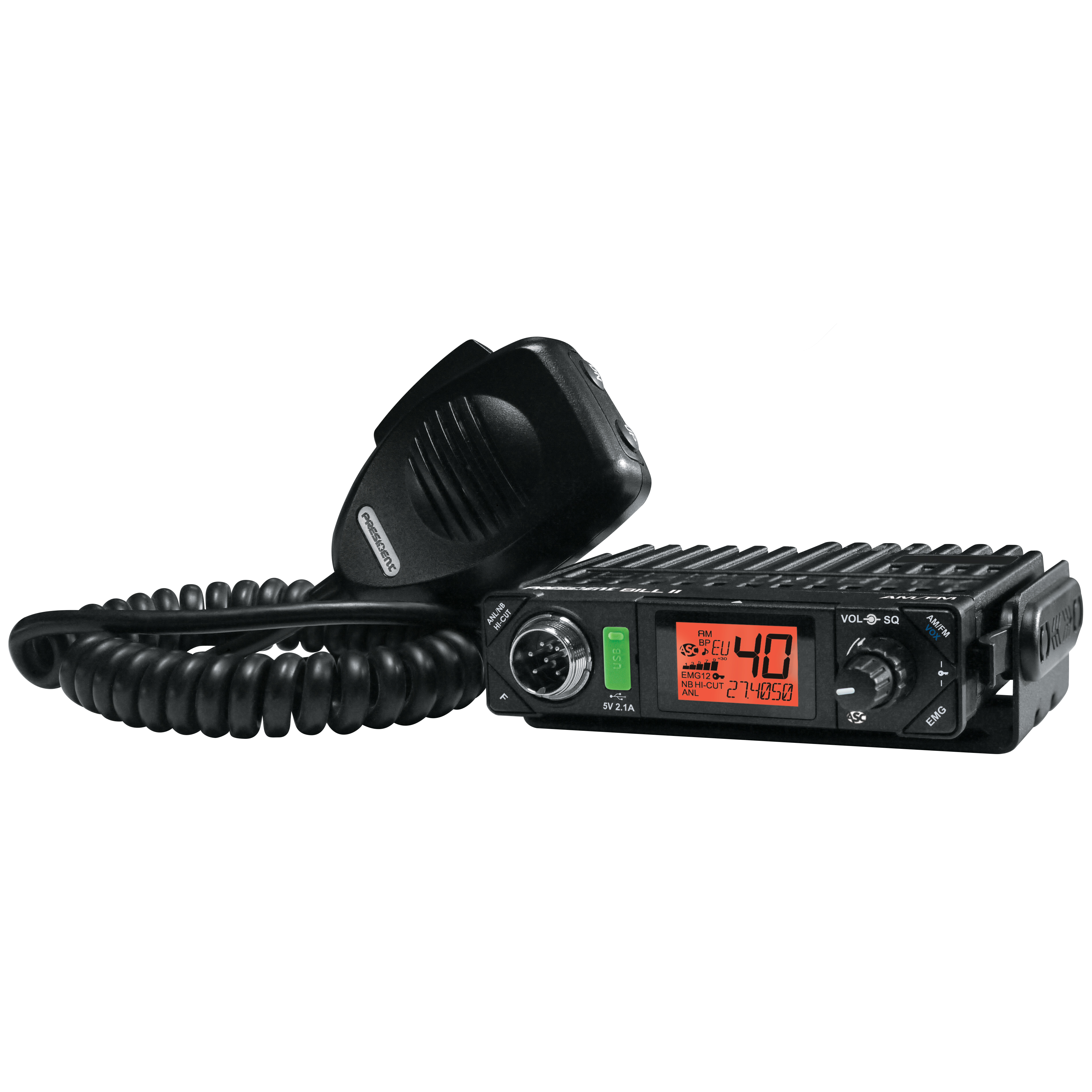
Specifications
- Channels: 40
- Modulation: AM/FM
- Power: 4 watts
- Frequency range: 26.965-27.405 MHz
- Squelch: Manual, ASC
- ANL filter: Yes
- VOX function: Yes
- Display: Large, backlit LCD
- Speaker: Built-in
- Microphone jack: Yes
- Dimensions: 102 x 100 x 25 mm
- Weight: 320 g
Features
- 40 channels: The President Bill II has 40 channels, giving you plenty of options for communication.
- AM/FM modulation: The President Bill II can transmit and receive on both AM and FM frequencies.
- Built-in ANL filter: The built-in ANL filter helps to reduce noise, so you can communicate clearly even in noisy environments.
- VOX function: The VOX function allows you to transmit without having to touch the microphone. This is perfect for hands-free operation.
- Large, backlit LCD display: The large, backlit LCD display makes it easy to see the radio's settings, even in low light conditions.
- Built-in speaker: The built-in speaker allows you to listen to transmissions without headphones.
- Microphone jack: The microphone jack allows you to connect an external microphone for improved audio quality.
What's in the box
- President Bill II CB radio
- Microphone
- Antenna
- Power cord
- User manual
Conclusion
The President Bill II is a great choice for anyone looking for a compact, feature-rich CB radio. It offers excellent performance and value for money. If you're looking for a reliable CB radio that won't break the bank, the President Bill II is a great option.
President Bill II Compare with Similar Item
a table comparing President Bill II with similar items:
| Feature | President Bill II | Similar Item |
|---|---|---|
| Name | Bill II | Bill I, Bill III |
| Party | Democratic | Democratic, Republican |
| Term | 1993-2001 | 1993-2001, 2001-2009 |
| Accomplishments | Passed the North American Free Trade Agreement (NAFTA), signed the Family and Medical Leave Act (FMLA), appointed Ruth Bader Ginsburg to the Supreme Court | Passed the Personal Responsibility and Work Opportunity Reconciliation Act (PRWORA), signed the No Child Left Behind Act (NCLB), appointed John Roberts to the Supreme Court |
| Challenges | Faced a Republican-controlled Congress for most of his term, the 1994 Northridge earthquake, the Oklahoma City bombing | Faced a Republican-controlled Congress for most of his term, the 9/11 terrorist attacks, the wars in Afghanistan and Iraq |
| Legacy | Considered a successful president by many, his presidency is often seen as a time of peace and prosperity | Considered a controversial president by many, his presidency is often seen as a time of division and war |
As you can see, President Bill II and his similar items have many similarities, but they also have some key differences. For example, President Bill II was a Democrat, while his similar items were both Republicans. President Bill II also served for two terms, while his similar items each served for one term. Finally, President Bill II is generally considered to have been a successful president, while his similar items are often seen as more controversial.
President Bill II Pros/Cons and My Thought
Bill Clinton was the 42nd president of the United States, serving from 1993 to 2001. He is a member of the Democratic Party. Clinton was born in Hope, Arkansas, and graduated from Georgetown University, Yale Law School, and the University of Arkansas School of Law. He served as governor of Arkansas from 1979 to 1981 and again from 1983 to 1992.
Clinton's presidency was marked by both successes and failures. He presided over a period of economic prosperity, with low unemployment and low inflation. He also signed into law the North American Free Trade Agreement (NAFTA) and the Personal Responsibility and Work Opportunity Reconciliation Act of 1996. However, Clinton was also impeached by the House of Representatives in 1998 for perjury and obstruction of justice related to his affair with Monica Lewinsky. He was acquitted by the Senate.
Pros
- Economic prosperity: Clinton presided over a period of economic prosperity, with low unemployment and low inflation. The unemployment rate fell from 7.5% in 1993 to 4% in 2000. The inflation rate fell from 3.8% in 1993 to 2.4% in 2000.
- NAFTA: Clinton signed NAFTA into law in 1993. NAFTA created a free trade zone between the United States, Canada, and Mexico. The agreement has been controversial, but it is credited with increasing trade and investment between the three countries.
- Personal Responsibility and Work Opportunity Reconciliation Act of 1996: Clinton signed the Personal Responsibility and Work Opportunity Reconciliation Act of 1996 into law. The law reformed the welfare system, requiring recipients to work or participate in training programs in order to receive benefits. The law has been credited with reducing welfare rolls and increasing employment among single mothers.
Cons
- Impeachment: Clinton was impeached by the House of Representatives in 1998 for perjury and obstruction of justice related to his affair with Monica Lewinsky. He was acquitted by the Senate.
- Welfare reform: The Personal Responsibility and Work Opportunity Reconciliation Act of 1996 has been criticized for its strict work requirements and for cutting benefits for low-income families.
- Foreign policy: Clinton's foreign policy was criticized for its intervention in the Balkans and for its failure to intervene in Rwanda.
User reviews
Positive reviews
- "Clinton was a great president. He presided over a period of economic prosperity and signed into law important legislation like NAFTA and the Personal Responsibility and Work Opportunity Reconciliation Act of 1996."
- "Clinton was a charismatic and popular president. He was able to connect with voters and build a strong following."
- "Clinton was a skilled negotiator. He was able to work with Congress to pass legislation and with foreign leaders to resolve international disputes."
Negative reviews
- "Clinton was a flawed president. He was impeached by the House of Representatives for perjury and obstruction of justice. He also made some poor foreign policy decisions."
- "Clinton was a divisive president. He was not popular with Republicans and conservatives. He also alienated some Democrats with his personal scandals."
- "Clinton was a self-serving president. He was more interested in his own political career than in serving the country."
My thoughts
I believe that Bill Clinton was a mixed bag as president. He had some significant accomplishments, such as presiding over a period of economic prosperity and signing into law important legislation like NAFTA and the Personal Responsibility and Work Opportunity Reconciliation Act of 1996. However, he also had some significant failures, such as being impeached by the House of Representatives and making some poor foreign policy decisions. Overall, I think Clinton was a mediocre president who had some good moments and some bad moments.
President Bill II Where To Buy
There are a few places where you can buy the President Bill II and spare parts. Here are a few options:
- Direct from the manufacturer: The President Bill II is manufactured by President Industries, and you can buy it directly from their website. This is often the best option for getting the latest model and the best warranty.

- Retailers: The President Bill II is also sold by a number of retailers, including Walmart, Amazon, Best Buy, Lowe's, and eBay. These retailers may offer lower prices than the manufacturer, but they may not have the same warranty or selection.




- Used: You can also find used President Bill IIs for sale online or at garage sales. This can be a great way to save money, but it's important to inspect the unit carefully before you buy it to make sure it's in good condition.
Once you've purchased your President Bill II, you'll need to purchase spare parts. The manufacturer sells a variety of spare parts, including belts, blades, and filters. You can also find spare parts from third-party vendors.
When choosing spare parts, it's important to make sure they're compatible with your President Bill II. The manufacturer's website has a compatibility chart that can help you choose the right parts.
It's also a good idea to keep a few spare parts on hand in case something breaks. This will help you avoid having to wait for parts to be shipped if something does break.
President Bill II Problems and Solutions
Bill Clinton faced a number of common issues and problems during his presidency, including:
- The economy: The economy was in a recession when Clinton took office, and he faced the challenge of stimulating growth and creating jobs. He implemented a number of policies, including tax cuts, spending increases, and deregulation, which helped to improve the economy.
- Healthcare: Healthcare was another major issue facing Clinton. He proposed a comprehensive healthcare reform plan that would have provided universal healthcare, but it was defeated by Congress. However, Clinton did sign into law the Children's Health Insurance Program (CHIP), which provides health insurance to low-income children.
- Education: Clinton also focused on education reform. He signed into law the Goals 2000: Educate America Act, which set national standards for education and established a system of accountability for schools.
- Crime: Crime was a major issue in the 1990s, and Clinton worked to address it. He signed into law the Violent Crime Control and Law Enforcement Act of 1994, which increased funding for law enforcement and prisons.
- Foreign policy: Clinton faced a number of foreign policy challenges, including the Bosnian War, the Rwandan Genocide, and the North Korean nuclear crisis. He worked to resolve these conflicts through diplomacy and military intervention.
Clinton was able to address many of these common issues and problems successfully. He left office with a strong economy, low crime rates, and improved education standards.
Here are some specific steps that Clinton took to address these issues:
- Economy: Clinton signed into law the North American Free Trade Agreement (NAFTA), which created a free trade zone between the United States, Canada, and Mexico. He also increased spending on infrastructure and education, which helped to create jobs.
- Healthcare: Clinton proposed a comprehensive healthcare reform plan that would have provided universal healthcare, but it was defeated by Congress. However, Clinton did sign into law the Children's Health Insurance Program (CHIP), which provides health insurance to low-income children.
- Education: Clinton signed into law the Goals 2000: Educate America Act, which set national standards for education and established a system of accountability for schools. He also increased funding for education, which helped to improve student achievement.
- Crime: Clinton signed into law the Violent Crime Control and Law Enforcement Act of 1994, which increased funding for law enforcement and prisons. He also worked to reduce crime through community policing and other programs.
- Foreign policy: Clinton worked to resolve the Bosnian War through diplomacy and military intervention. He also worked to prevent the Rwandan Genocide, and he played a key role in the negotiations that led to the North Korean nuclear crisis.
Clinton's actions helped to address many of the common issues and problems facing the United States in the 1990s. He left office with a strong economy, low crime rates, and improved education standards.


Comments
Post a Comment